Disclaimer: This is general advice for static caravan buyers. Some details may not apply to our park, so please check with our team before making any decisions.
Quick Takeaways
- Static caravans: 12–14ft wide (single unit)
- Holiday lodges: 14–22ft wide (twin unit)
- Build standards: EN 1647 vs BS 3632
- Licence terms: 10–20 years vs 25–30+ years
- Starting price: £35k+ vs £90k+
- Usage: Holiday use only (not residential)
Ads by Salop Caravan Sites
Scroll to continue with content
What This Guide Covers
- Core differences: size, width, and layout
- Build standards: EN 1647 vs BS 3632 comfort levels
- Cost comparison: purchase price and running costs
- Licence terms and depreciation rates
- Lifestyle factors: parking, soundproofing, and winter use
- Pitch availability and why some options are harder to secure
- A simple decision framework to help you choose
1. Introduction
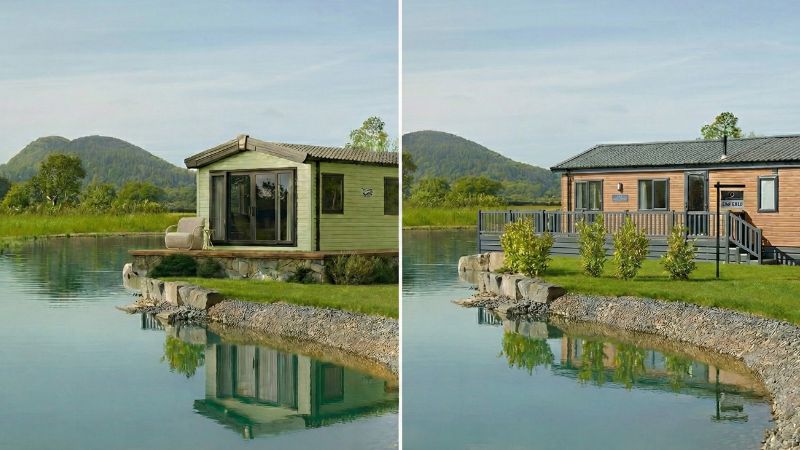
Walk onto almost any holiday park in the UK and you’ll usually see two main types of holiday home:
- One that looks like the caravan you remember from childhood.
- One that looks more like a timber bungalow or villa.
Choosing between a static caravan and a holiday lodge is a big decision. It affects your upfront budget, your annual running costs, and how many years you can keep the holiday home on the park.
This guide is written for buyers looking at parks in Mid Wales, but the principles apply across the UK. The aim is a clear, practical comparison — not sales talk.
One common trade-off we see in rural areas like Mid Wales is simple: upfront price vs winter comfort and licence length. This guide helps you weigh that up without getting lost in jargon.
Important: A holiday lodge is not the same as a residential park home. Even if a lodge is built to BS 3632 residential specification, if it is on a holiday park with a holiday licence, you cannot live in it full-time. It is for holiday use only, and you must have a separate main home.

2. Understanding the Basics
2.1 What is a static caravan?
A static caravan is a holiday home designed to stay on one pitch. Most static caravans on UK holiday parks are single-unit homes delivered on one transporter.
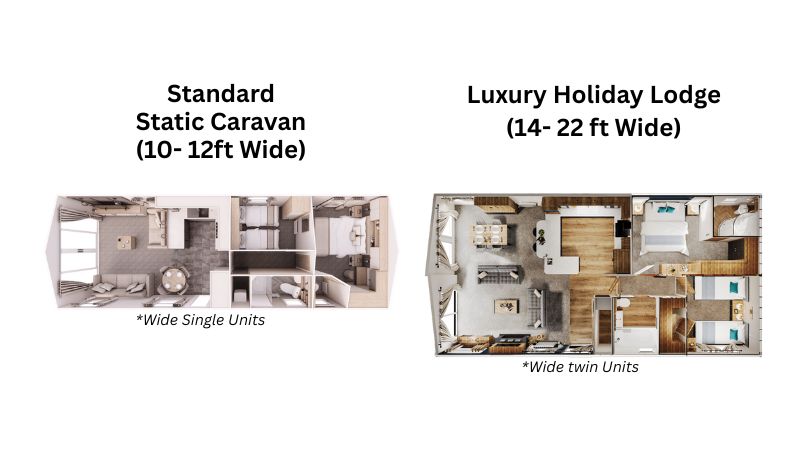
- Size: Usually 12–14ft wide, around 28–40ft long.
- Construction: Aluminium or vinyl cladding on a timber or steel chassis.
- Standards: Many are built to EN 1647 holiday specification. Some higher-spec models are built to BS 3632.
- Siting: Often on a hardstanding base (gravel or concrete), supported by jacks and steady stands. Some parks use full concrete pads.
- Use: Holiday use only. You must have a separate main residence.
In short: a static caravan is a single-width holiday home that offers good value, especially for shorter, frequent breaks.
2.2 What is a holiday lodge?
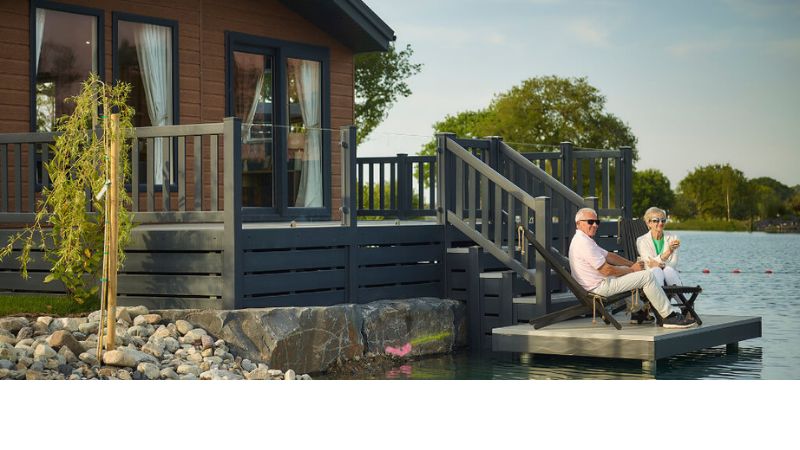
A holiday lodge is usually a twin-unit holiday home. It arrives in two halves that are joined together on your pitch.
- Size: Often 14–22ft wide, with many modern lodges around 20–22ft wide and up to 40ft+ long.
- Construction: Usually built to BS 3632 residential specification. Thicker walls, higher insulation, and double glazing as standard. (A few lodges may be EN 1647, so always check the spec.)
- Foundation: Commonly sited on a concrete raft foundation, which adds stability and a more permanent feel.
- Interior feel: More like a small house or apartment than a caravan, often with domestic-style kitchens and bathrooms.
In short: a holiday lodge is a double-width, higher-spec holiday home with more space and comfort — still for holiday use only.
2.3 What they have in common
Despite the differences, statics and lodges share some key points:
- Both are classed as mobile structures, not bricks-and-mortar houses.
- Both are sold for holiday and recreational use only.
- You pay site (pitch) fees to keep them on the park.
- You need specialist holiday home insurance.
- You must have a main residential address elsewhere.

3. Key Differences at a Glance
If you’re short on time, start here.
| Feature |
Static Caravan |
Holiday Lodge |
| Width |
10–12ft (single unit) |
14–22ft (twin unit) |
| Build Standard |
Typically EN 1647 |
Often BS 3632 (residential-spec comfort) |
| Foundation |
Hardstanding & jacks |
Concrete raft foundation (usually) |
| Insulation |
Good on modern models |
Excellent on many models |
| Licence Length |
10–20 years |
25–30+ years |
| Parking |
Usually 1 space |
Often 2 private spaces |
| Starting Price |
£35,000+ (new) |
£90,000+ (new) |
4. Cladding, Colours & Local Authority Rules
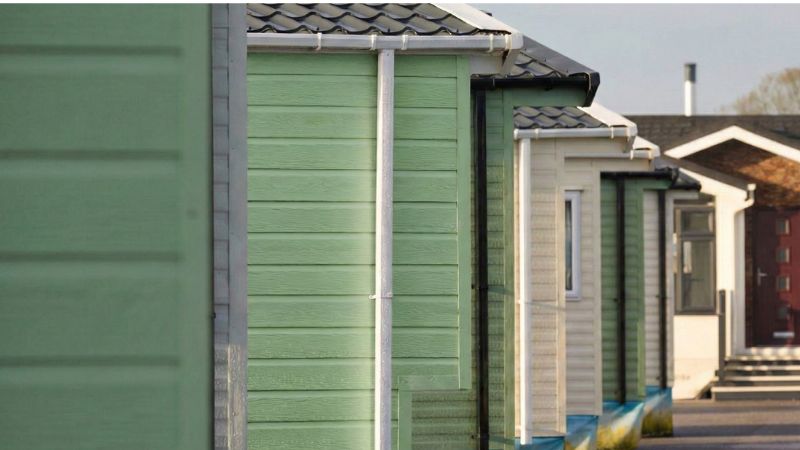
The outside of your holiday home affects more than looks. It can influence what’s permitted under planning conditions and how well the home blends into the local landscape.
How colours are often decided
Local authorities may set conditions on colours, cladding materials, and roof finishes. This is especially common in National Parks and Areas of Outstanding Natural Beauty (AONB).
Typical patterns:
- Rural areas: Environmental greens and muted tones are commonly used to blend into woodland and hillside settings.
- Coastal areas: Cream, light grey and sand tones are often used to soften the visual impact near beaches.
The lodge advantage (with a caveat)
- Static caravans: Usually aluminium or vinyl cladding.
- Holiday lodges: Often offer CanExel (composite wood) or timber cladding for a chalet-style look.
Warning: If every unit on the park is green, don’t assume a cream lodge will be allowed until you have written confirmation.
5. Cost Comparison
5.1 Initial purchase cost
Static caravans
- Pre-owned: Often available from £15,000–£25,000.
- New: On quality parks, often start from £35,000–£45,000.
- High-spec: Can reach £70,000–£80,000+.
Holiday lodges
- New: Typically start around £90,000–£110,000.
- Premium: Models with hot tubs and large decking can reach £200,000–£250,000+.
- Location: Scenic or more private lodge pitches often command a higher price.
5.2 Running costs
- Site fees: Lodge pitches are usually larger, and newer lodge areas can carry higher annual fees.
- Utilities: Lodges are larger to heat, but their insulation can mean a modern lodge costs less to run in colder months than an older caravan (depending on heating type and how often you visit).
- Maintenance: Aluminium caravan cladding is wipe-clean. Timber or CanExel lodge cladding may need occasional treatment.
5.3 Depreciation & long-term value
Both are depreciating assets, not bricks-and-mortar property.
- Static caravans: Often depreciate faster in early years. Shorter licence terms can mean upgrading sooner.
- Holiday lodges: Longer licence terms and higher build standards can help them retain value better in some cases, especially on well-run parks with strong demand for lodge pitches.
6. Lifestyle & Comfort Comparison
6.1 Space and layout
Space is where many buyers feel the biggest difference.
- Static caravan (12ft wide): Open-plan lounge/kitchen with a corridor to bedrooms. Smart use of space, but compact.
- Holiday lodge (20ft wide): Wider open-plan living with room for full-size furniture. Some include a utility space and a proper dining table. On a wet weekend, the extra width can matter.
The parking factor
- Statics: Usually one private space or shared parking.
- Lodges: Often two private spaces close by, which suits families arriving in two cars.
6.2 Soundproofing
Lodges built to BS 3632 usually have thicker walls and better acoustic performance. You’ll often notice less roof noise in heavy rain and less sound transfer between neighbouring units.
6.3 Length of stays & season use
- Static caravan: Suits short, frequent trips. Warms up quickly and is easy to close down.
- Holiday lodge: Often better for longer stays and off-peak visits where you spend more time indoors.
7. Ownership Experience
7.1 Licence tenure (the “lease”)
Your pitch licence agreement sets out how long your unit can stay on that pitch.
- Static caravans: Commonly 10–15 years (sometimes up to 20).
- Holiday lodges: Frequently 25–30 years (sometimes longer).
A longer licence can make a higher upfront cost easier to justify over time.
7.2 Pitch availability & scarcity
- Caravan pitches: More widely available across most parks.
- Lodge pitches: Lodges take more space and are typically limited. Prime pitches (views, privacy, quieter corners) can be scarce.
7.3 Park types
- Caravan areas: Often more mixed and family-focused.
- Lodge developments: Often quieter and landscaped, sometimes with tighter rules to protect the feel.
7.4 Legal & planning – the golden rule
BS 3632 (Residential Spec) ≠ Residential Status.
If your holiday home is on a holiday park, you cannot use it as your main home. You must pay Council Tax elsewhere. Parks may ask for proof of this.
7.5 Subletting & letting income
Lodges can achieve higher weekly rental rates due to their size and spec. Always check whether your specific park allows subletting before buying, and ask how it’s managed (owner-run, park-run, or restricted).
Note for Morben Isaf: Morben Isaf is an owners-only park and does not allow subletting. This is intentional — it helps keep the community stable and the atmosphere quieter for owners.
8. Who Should Choose a Static Caravan?
A static caravan is usually the right choice if:
- Budget is tight or mid-range: You want the lifestyle without the lodge price tag.
- Short breaks: You visit for weekends and bank holidays.
- First-time buyer: A sensible way to test the lifestyle.
- Low maintenance: You prefer easy-clean exteriors and compact spaces.
9. Who Should Choose a Holiday Lodge?
A holiday lodge is usually the better fit if:
- Space is a priority: You host family and guests often.
- All-season comfort: You want a warmer base for colder months.
- Parking: Two spaces matter to you.
- Long-term plan: You want a base for 20+ years.
- Income: You want stronger letting potential (where allowed).
10. Key Trends to Watch
- Efficiency upgrades: Better insulation options on many modern statics are narrowing the comfort gap.
- Heating changes: Some parks are moving toward electric heating and away from bottled gas.
- Smart tech: App-controlled heating is increasingly common in higher-spec models.
11. Decision Framework
Use this quick checklist if you’re still unsure.
- Budget: Under £60k? → Static caravan.
- Visit pattern: Mostly weekends? → Static. Regular long stays? → Lodge.
- Time horizon: 5–10 years? → Static. 20+ years? → Lodge.
- Experience: First-time buyer? → Static. Upgrading? → Lodge.
12. Conclusion & Next Steps
There is no single “better” option. There is only the option that fits your budget, your visit pattern, and your long-term plans.
- A static caravan offers an accessible, flexible starting point.
- A holiday lodge offers more space and comfort, with longer licence terms on many parks.
Best next step: Don’t decide from photos alone. Visit a park, step into a 12ft static caravan and then a 20ft lodge. Sit down, walk around, stand in the kitchen. You’ll quickly feel which space fits your life.
If you’re shortlisting options, these are sensible next steps:
13. Why Choose Salop Caravan Sites
Across Salop Caravan Sites parks in Mid Wales, owners benefit from:
- Fair, transparent pricing.
- Well-maintained countryside and coastal settings.
- Owners-only areas and quieter developments for predictable, peaceful stays.
- Experienced, approachable park managers who offer straightforward advice.
- Clear information and no hidden conditions.
Each park has its own character, but the focus is consistent: peaceful ownership, long-term value, and clarity from the first conversation to the last.
Frequently Asked Questions (FAQ)
Can I live permanently in a holiday lodge?
No. Even if your lodge is built to BS 3632 residential specification, if it is sited on a holiday park, you cannot use it as your main home. You must have a primary residence elsewhere.
Do holiday lodges hold their value better?
In some cases, yes. Because they’re built to a higher specification and often sit on pitches with longer licence terms, they can depreciate more slowly. However, all holiday homes are depreciating assets.
Are site fees higher for lodges?
Often yes. Lodge pitches take up more space and are sometimes on premium developments, which can mean higher annual fees.
What is the difference between BS 3632 and EN 1647?
- EN 1647: European standard for holiday caravans (seasonal use).
- BS 3632: British Standard for residential-spec comfort (higher insulation and comfort levels).
Can I get a mortgage on a holiday lodge?
No, because you do not own the land. However, specialist holiday home finance is available (subject to status and park approval).

Disclaimer: This guide is for general information only and reflects typical industry practice as of 2025/2026. While we aim for accuracy, we make no representations or warranties about the completeness, accuracy, or reliability of the information provided, and we accept no liability for any errors or omissions. Costs, policies, licence terms, and facilities vary between parks and manufacturers and may change without notice. Any reliance you place on this information is at your own risk — always confirm details directly with the park manager before making any purchase decision. This content does not constitute financial, legal, or professional advice. If you need specific guidance, please consult a qualified professional.